
Cold storage doors are exposed to working conditions that are very different from those of ordinary building doors. Frequent opening and closing, temperature differences, heavy insulated door panels, moisture, and strict requirements for sealing can all place additional demands on the door hardware. Among these components, the hinge directly affects door movement, alignment, serviceability, and long-term operating stability.
For cold room contractors, refrigeration equipment distributors, maintenance companies, and door manufacturers, selecting a suitable hinge is therefore not simply a matter of choosing a component that can support the door. The hinge should also allow appropriate adjustment, maintain stable movement, simplify maintenance, and work effectively with the overall door structure.
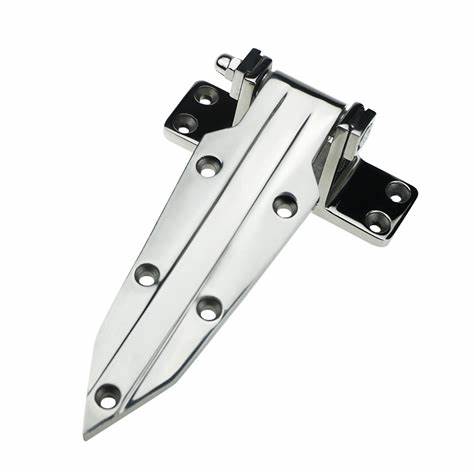
The Cold Storage Room Door Hinge from Sanheng is designed around these practical requirements. Its split hinge-body structure allows the door to be removed for maintenance, while adjustment holes provide flexibility for correcting the door position and gaps after installation.
Cold room doors are commonly constructed with insulated panels that are considerably heavier than many standard interior doors. The hinge therefore needs to maintain stable support while the door is repeatedly opened and closed.
If the hinge or installation structure is not properly matched to the door, problems such as uneven gaps, difficult operation, misalignment, or accelerated hardware wear can occur. For this reason, hinge selection should be considered together with the door panel, frame, sealing system, and installation method.
Cold storage environments can involve significant temperature differences between the inside and outside of the room. Condensation and moisture may also occur around door areas depending on operating conditions.
Although the hinge is only one part of the complete cold room door assembly, its mechanical movement must remain reliable under the actual conditions of use. Proper material selection, installation, lubrication where applicable, and routine inspection all contribute to longer service life.
| Feature | Design / Configuration | Practical Benefit |
|---|---|---|
| Product Type | Cold storage room door hinge | Designed for cold room door applications |
| Hinge Structure | Hinge seat and hinge body | Provides the main connection between door and frame |
| Hinge Body | Two-section structure | Allows easier door removal for maintenance |
| Connection Method | Connecting plate | Joins the hinge sections into an integrated assembly |
| Vertical Adjustment | Long adjustment hole | Allows adjustment of the upper and lower door gap |
| Horizontal Adjustment | Long adjustment hole | Allows adjustment of the left and right door gap |
| Door Removal | Removable connecting plate | Facilitates maintenance and service work |
| Installation | Door and frame mounting | Suitable for integration into cold room door assemblies |
| Adjustment | Multi-directional adjustment | Helps correct door alignment after installation |
| Application | Cold storage room doors | Supports refrigeration and cold-room construction projects |
| Manufacturer | Sanheng | Refrigeration component manufacturer and supplier |
The manufacturer describes the hinge as having a hinge seat and hinge body, with adjustment holes in the connecting plate that allow the door gap to be adjusted vertically and horizontally. The split structure also allows the door to be removed by taking off the connecting plate, which can simplify maintenance work.
Cold room doors need to maintain an appropriate position relative to the frame and sealing surfaces. Even a small amount of misalignment can affect the door's movement or create uneven gaps around the perimeter.
The hinge incorporates a long adjustment hole for the upper and lower door gap. This provides installers with an opportunity to correct vertical alignment after the hinge and door have been positioned.
Horizontal alignment is equally important. If the door is shifted toward one side, the gap between the door panel and frame may become uneven.
The connecting plate includes an adjustment arrangement for the left and right gap. This makes the hinge more adaptable during installation and allows installers to fine-tune the door position rather than relying entirely on the original mounting position.
A cold storage door is part of the thermal boundary of the refrigerated space. The door, frame, gasket, and surrounding insulation work together to reduce unwanted heat exchange.
If the door is significantly misaligned, the sealing system may not make uniform contact around the perimeter. This can create practical problems for refrigeration efficiency and operating stability.
The hinge does not independently determine the sealing performance of the complete door. However, its adjustment capability can help installers position the door correctly so that the door and sealing system can work as intended.
An uneven door position can also place additional stress on hinges, fasteners, door frames, and sealing components. Correct alignment helps distribute mechanical loads more appropriately during opening and closing.
For commercial cold storage facilities where doors may be operated many times each day, proper initial adjustment can therefore contribute to more reliable long-term operation.
Maintenance requirements should be considered when selecting cold room hardware. In commercial refrigeration environments, unnecessary downtime can create operational difficulties, particularly when the cold room is used for food, pharmaceuticals, logistics, or other temperature-sensitive goods.
The Sanheng hinge uses a two-section hinge body connected through a removable connecting plate. According to the manufacturer's design, removing the connecting plate allows the door to be separated for repair or maintenance.
This structure can reduce the complexity of service work because maintenance personnel do not necessarily need to treat the entire hinge assembly as a permanently fixed unit.
Cold storage doors may eventually require gasket replacement, door-panel repair, hardware inspection, or other maintenance. A hinge that supports easier door removal can make these operations more manageable.
For contractors and maintenance companies, this is particularly useful when servicing multiple cold rooms where reducing installation and removal time can improve overall maintenance efficiency.
Before final tightening, installers should ensure that the hinge is correctly positioned relative to the door frame and door panel. The mounting surface should be stable, and the hinge should not be forced into an unsuitable position to compensate for an incorrectly installed frame.
The manufacturer's installation guidance emphasizes adjusting the hinge after installation so that the gap between the door and cabinet or frame is as even as possible.
The adjustment holes are most useful when installers take time to align the door before completing the final fixing process. The door should be checked from multiple directions to ensure that the upper, lower, left, and right gaps are appropriate.
After adjustment, all required fastening points should be securely fixed. Loose or incomplete fastening can compromise the stability of the hinge assembly and shorten its service life.
Before purchasing a cold storage hinge, buyers should provide the supplier with the door dimensions, approximate door weight, frame structure, opening direction, and expected operating frequency.
These factors help determine whether the selected hinge configuration is appropriate for the intended door assembly. A hinge should not be selected based only on appearance or general application terminology.
Different door installations may require different adjustment capabilities. Buyers should confirm whether the hinge can provide sufficient vertical and horizontal adjustment for their specific frame and door structure.
This is particularly important for projects involving prefabricated cold room panels, replacement doors, or existing structures where installation tolerances may vary.
For large cold storage facilities, serviceability can be an important procurement factor. Buyers should evaluate how easily the door can be removed, how the hinge can be inspected, and whether replacement parts or maintenance support are available.
A hardware component that is easier to service can help maintenance teams reduce unnecessary downtime over the operating life of the cold room.
Food warehouses and refrigerated distribution centers often use insulated doors that must be opened and closed repeatedly throughout daily operations. Stable door alignment and reliable hardware are important for maintaining practical workflow and minimizing unnecessary service interruptions.
Cold chain facilities can include storage rooms, distribution centers, processing areas, and loading zones. Door hardware in these environments needs to accommodate regular operation and maintenance requirements.
Supermarkets, restaurants, food processing facilities, and other commercial users may have multiple cold rooms with different door sizes and operating frequencies. Selecting adjustable and serviceable hinge components can simplify installation and future maintenance.
Cold room door manufacturers can also integrate suitable hinge systems into their door assemblies. For OEM projects, hinge dimensions, mounting structure, adjustment range, surface treatment, and packaging requirements should be confirmed before mass production.
Regular inspection can help identify early signs of door sagging, uneven gaps, unusual movement, or loose fasteners. These issues should be addressed before they develop into more serious mechanical problems.
Repeated opening and closing can gradually affect fastener tightness depending on the installation structure and operating environment. Maintenance personnel should inspect mounting points according to the facility's maintenance schedule.
Dirt, ice, moisture, and other contaminants around moving hardware can interfere with smooth operation. The hinge area should therefore be kept clean and checked regularly, especially in demanding cold-room environments.
Maintenance and lubrication requirements can vary according to the hinge design and operating conditions. Users should follow the supplier's instructions rather than applying unsuitable lubricants or maintenance procedures without confirmation.
A cold storage door hinge is a relatively small component, but its performance is connected to the overall door assembly. For this reason, buyers should evaluate the supplier's understanding of refrigeration applications as well as the consistency of the hardware itself.
Sanheng, operated by Ningbo Sanheng Refrigeration Automatic Control Components Co., Ltd., focuses on refrigeration components and cold storage equipment accessories. Its product range includes refrigeration solenoid valves, expansion valves, pressure regulators, compressors, condensers, and cold storage room parts.
The company is based in Fenghua District, Ningbo, Zhejiang, China, and supplies refrigeration-related components for different applications. Its broader product portfolio gives buyers an opportunity to source cold storage hardware and refrigeration control components from a supplier familiar with the wider refrigeration industry.
Sanheng focuses on practical installation and maintenance requirements in the design of its cold storage door hinge. The two-section hinge body and removable connecting plate can simplify door removal, while the adjustment holes provide flexibility for correcting the door position after installation.
For cold room contractors, refrigeration equipment distributors, door manufacturers, and maintenance companies, these details can be more valuable than purely cosmetic features. A hinge that is easier to align and service can contribute to smoother installation and more manageable maintenance procedures.
The performance of a cold storage door depends on the interaction between the door panel, frame, gasket, locking system, hinges, insulation, and installation quality. Selecting one component without considering the complete assembly can lead to compatibility or performance issues.
For this reason, buyers should evaluate hinge load requirements, adjustment range, mounting dimensions, door structure, operating frequency, environmental conditions, and maintenance requirements before placing an order.
The Cold Storage Room Door Hinge from Sanheng provides a practical solution for cold room door assemblies where alignment adjustment and serviceability are important considerations. Its adjustable connection structure and removable hinge-body design make it suitable for installation, maintenance, and replacement scenarios across different refrigeration projects.
For B2B buyers, the most reliable procurement approach is to provide detailed door specifications and application conditions to the manufacturer before ordering. This allows the hinge configuration to be matched more accurately with the actual cold storage door system and helps reduce installation problems during project execution.


